

As folks embark on summer travels, I thought it was a good time to share our recent experience of being welcomed as family by a distant Jewish congregation. Note that this often requires some pre-planning because, while visitors are generally welcome, many congregations require advance notice to conduct background checks.
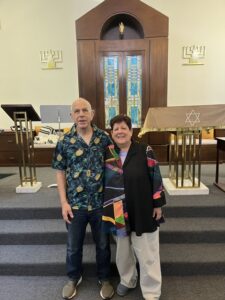
In May, my husband, Howard Oppenheim, and I were in Puerto Rico attending my Peace Corps Honduras reunion. At the suggestion of a friend, I streamed Shabbat services, and then I reached out to San Juan’s Reform (UJR-AmLat) congregation, Temple Beth Shalom (currently 98 member families). Shabbat services are held every Friday evening at 8:00 PM (Hebrew and English) and Saturday morning (Hebrew and Spanish). Additionally, a monthly children’s service is at 7:00 PM, and services are held on the holidays. TBSPR welcomes travelers, but for security reasons, visitors must notify the congregation beforehand. (In my email message, I noted that I would be observing my grandmothers’ yahrzeits and their names were added to the congregation’s list.) The newly-installed rabbi, Hernán Rustein (from Argentina), received his rabbinical training through the Ibero-American Institute for Reform Rabbinical Education (Instituto Iberoamericano de Formación Rabínica Reformista (IIFRR)). He is supported by a young, talented cantorial assistant, Angela, who grew up in the congregation. The services are streamed, with prayers posted in the three languages (Hebrew, Spanish, and English) and recorded. On Saturday morning, the congregation uses Gates of Unity for Shabbat – A Tri-lingual Siddur (in Hebrew, Spanish, English) (1997). Gates of Unity, derived from the CCAR’s Gates of Prayer, was produced by the Siddur Project Committee of Congregacion B’nei Israel, San Jose, Costa Rica. The Siddur Project was the brainchild of David Losk, a USAID official whom I knew from the Jewish community in Tegucigalpa, Honduras, where I served as a Peace Corps Volunteer from 1978 to 1980. Although Howard does not speak Spanish, we both easily followed the Hebrew service, which was very similar to Temple Sinai’s.
After services, we were invited to join the weekly kiddush. Following the blessings, we were introduced, and congregants shared family updates before sitting down to the vegetarian/dairy meal. The coconut challah, baked weekly by a member, was amazing, and the rice and salad dishes were delicious. The warm welcome extended to us and the opportunity to participate in the weekly community lunch were highlights of our trip.
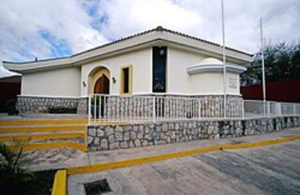 But there’s more to this mishpacha story: David Losk, mentioned above, played a part in facilitating Temple Sinai’s support for the Tegucigalpa, Honduras, Jewish community. In 1997, a small synagogue, Shevet Ajim, was built in Tegucigalpa. Five years later, as a result of hurricane flooding, the synagogue was on the verge of collapse. Encouraged by Barbara Kraft, who then chaired Temple Sinai’s social action committee (now part of Temple Sinai’s Davis Center), I submitted a grant application to request funding to help Shevet Achim shore up its foundation. Temple Sinai awarded the grant, but transmitting the funds internationally posed a challenge. Our dilemma was resolved by David Losk, who was able to accept and transfer the money to Shevet Ajim. Last June, when I was in Honduras, I drove by Shevet Ajim. The synagogue is in use, but it was locked the Sunday I was in Tegucigalpa. Nonetheless, I was pleased to see the impact of Temple Sinai’s generosity. Two decades after its near collapse, the synagogue, set on a firm foundation, can meet the needs of the small Jewish community in Honduras’s capital.
Shevet achim gam yachad: How wonderful it is for “family” to visit and support one another. I encourage all who are traveling, within or beyond the U.S., to consider visiting local Jewish congregations.
– Terri Salus