


Beginning in the fall of 2017, a group of congregants worked with Rabbi Hannah Goldstein to lay the groundwork for Multiracial Sinai (MRS). MRS became a formal Temple committee in 2019.
The purpose of Multiracial Sinai is to provide guidance in affirming Temple Sinai’s identity as a multiracial congregation and in identifying opportunities for improvement in aspects of our congregational life. Multiracial Sinai is committed to supporting these steps by helping guide Temple Sinai in being an antiracist congregation. Our vision is a congregation where differences are celebrated, where we have conversations about race, and where all feel welcome.
Temple Sinai has wholeheartedly embraced the Union of Reform Judaism’s 2017 resolution that both reaffirms our movement’s commitment to racial justice and commits the Reform movement to undertake transformative internal steps. Importantly, the resolution affirms our identity as a multiracial Reform Jewish community. Today, more than 10 percent of all Reform Jews identify as Jews of color, a term used to identify Jews whose family origins are originally in Africa, Asia, or Latin America. Jews of color may identify as Black, Latino, Asian American or as mixed heritage such as biracial or multiracial.
Temple Sinai’s own membership reflects this diversity. Our congregation benefits also from the active participation and support of our non-Jewish members who strengthen our community and are often active partners in raising Jewish children. Similar to our Jewish membership, our non-Jewish members are ethnically and racially diverse.
Temple-wide programming to create learning opportunities for the congregation and the wider community. Through programs on topics such as the legacy of housing discrimination, reparations for slavery and institutional racism, and the disproportionate impacts of medical debt, we seek a congregation that is both better informed and better prepared to act to correct these injustices. Our Building Racial Stamina facilitated discussion groups sought to empower congregants to see themselves as change agents for racial equity, and to build the shared language and skills for collaborative anti-racist action both inside and outside Temple Sinai’s walls.
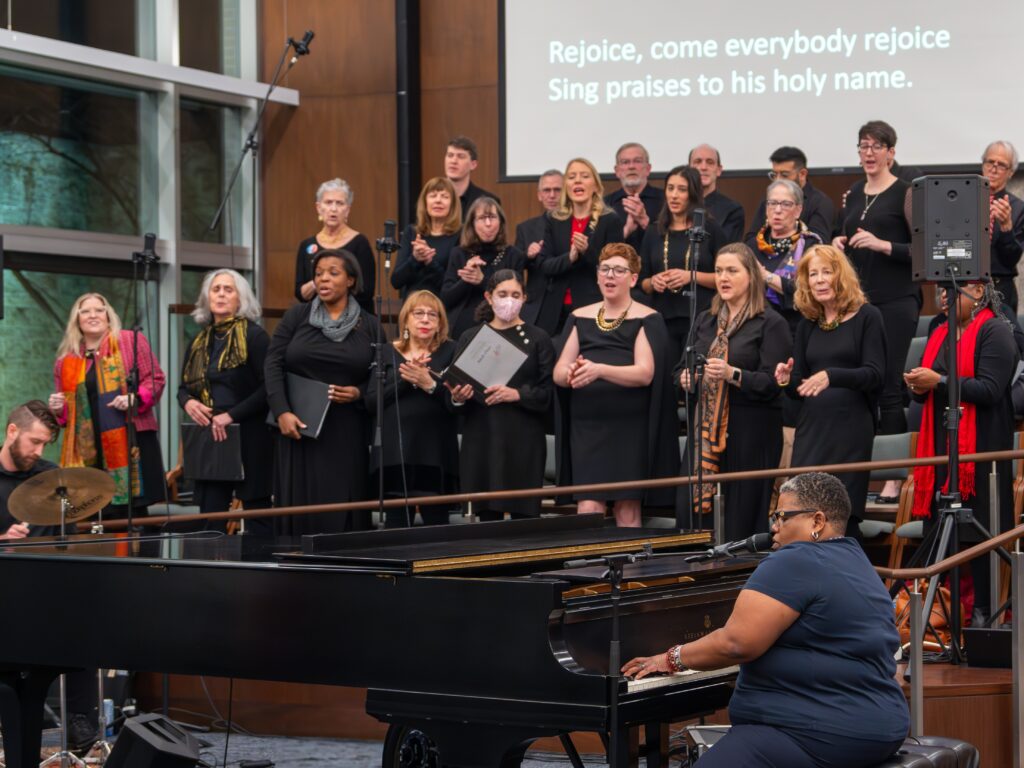
Integrating a racial justice lens and an appreciation for the diversity of the Jewish experience into our ritual, text study and learning, liturgy and music, and other aspects of our spiritual practices. Our annual Multiracial Sinai Shabbat service is just one example.
Engaging Temple youth in learning and action for racial justice.
In coordination with the Davis Center for Social Justice, promoting opportunities for congregants to take action to address racial inequities and injustices in our community. From housing justice to reproductive freedom, the impact of climate change or mistreatment of workers in today’s economy, nearly every social problem in the United States has a disproportionate impact on people of color due to the legacy of slavery, Jim Crow and legalized racism, and continuing structural racism. We lift up opportunities for social and racial justice action in partnership with allies, such as participating in Washington Interfaith Network (WIN) and the Poor People’s Campaign.
Multiracial Sinai members reflect the diversity of the Jewish community. While the majority of participants are white Jews, we prioritize the participation and leadership of Jews of Color and people of color in the Temple Sinai community, including affinity spaces for congregants of color and their families. Multiracial Sinai utilizes an intentional and deliberative process where members of the committee are committed to ongoing learning and developing skills in being antiracist. Our committee membership is structured to achieve maximum inclusion and participation, with the understanding that we are all in different places in our anti-racist journey and the varied talents we bring to the effort of creating a racially just society are collectively necessary for our movement. We also know that each and every one of us has more to learn – and unlearn – about racism and white supremacy in this country, our synagogue and ourselves. To that end, we integrate a commitment to embrace on-going learning within the committee so that we can consistently reflect on our work, hold it to the light and learn and pivot. We welcome new committee members who are committed to this work and to devoting their time, energy and imagination to advancing our goals.
Beyond the committee, MRS maintains a listserv with over 240 recipients, including over 120 congregants who have participated in the Building Racial Stamina facilitated discussion groups led by Multiracial Sinai. MRS has pages on both the temple’s website and that of the Davis Center, with information about past and present initiatives, and regularly communicates about our programming via the temple’s weekly email.
In 2024, at the recommendation of the Multiracial Sinai Committee, Temple Sinai joined the SEA Change initiative, bringing together Jewish congregations across denominations in the DMV, in a shared network to Study, Engage and Act toward racial justice, equity and inclusion for all. Through SEA Change we inform our congregants of opportunities these other congregations offer to learn and to act to advance our common goals, and invite their members to join in our activities as well.
The commitment to striving to be anti-racist informs every dimension of the work of Multiracial Sinai.
By now we have all heard the term “antiracist” but what does it mean to you and for our Temple Sinai community? The Multiracial Sinai Committee (MRS) has been working towards guiding Temple Sinai in being affirmatively antiracist since 2018. Members of MRS and other congregants gathered on November 11 in conversation about what it means to be antiracist in our own lives, and what each of us can do to advance the goal of making Temple Sinai an antiracist congregation.
On Tuesday, May 17, 2022 Temple Sinai, the Davis Center and Multiracial Sinai sponsored an engaging and important program called Beyond the Count: Perspectives and Lived Experiences of Jews of Color. More than 75 people from 7 area congregations gathered at Temple Sinai to learn from Ilana Kaufman, Executive Director of the Jews of Color Initiative, about the multiracial reality of the Jewish people, how systems of inequality are perpetuated in our own Jewish spaces, and opportunities for powerful intervention.
Described by participants as “provocative and mind-expanding,” we were called to action – to transform our houses of worship into antiracist communities, places of belonging where all Jews of Color are able to bring their whole selves even to primarily White Jewish spaces.
Temple Sinai leaders Deitra Reiser, Dora Chen and Anthony Murphy engaged participants through a candid and provocative conversation with Ilana Kaufman about their experiences in Jewish spaces and their aspirations for more open spaces of belonging that reflect our multiracial Jewish world.
Ms. Kaufman summoned all attendees to support the leadership of Jews of Color and initiatives and organizations led by Jews of Color, and to shift Jewish organizational leadership to reflect the multiracial diversity of American Jews.
The program was sponsored by the following congregations, in partnership with Temple Sinai: Adas Israel Congregation, Sixth & I, Temple Emanuel, Temple Micah, Temple Shalom, and Washington Hebrew Congregation.
Read the report from the Jews of Color Initiative: Beyond the Count: Perspectives and Lived Experiences of Jews of Color


Below you will find links to the videos of the series, a blog post about Reparations and some wonderful resources about Reparations.
Resources:
General watching/listening/reading:
Sermons:
Books:
We use cookies to improve your experience on our site. By using our site, you consent to cookies.
Websites store cookies to enhance functionality and personalise your experience. You can manage your preferences, but blocking some cookies may impact site performance and services.
Essential cookies enable basic functions and are necessary for the proper function of the website.
These cookies are needed for adding comments on this website.
These cookies are used for managing login functionality on this website.
Statistics cookies collect information anonymously. This information helps us understand how visitors use our website.
Google Analytics is a powerful tool that tracks and analyzes website traffic for informed marketing decisions.
Service URL: policies.google.com (opens in a new window)
You can find more information in our Cookie Policy and .

